

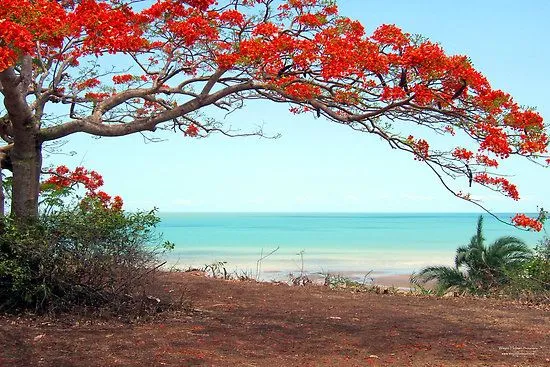
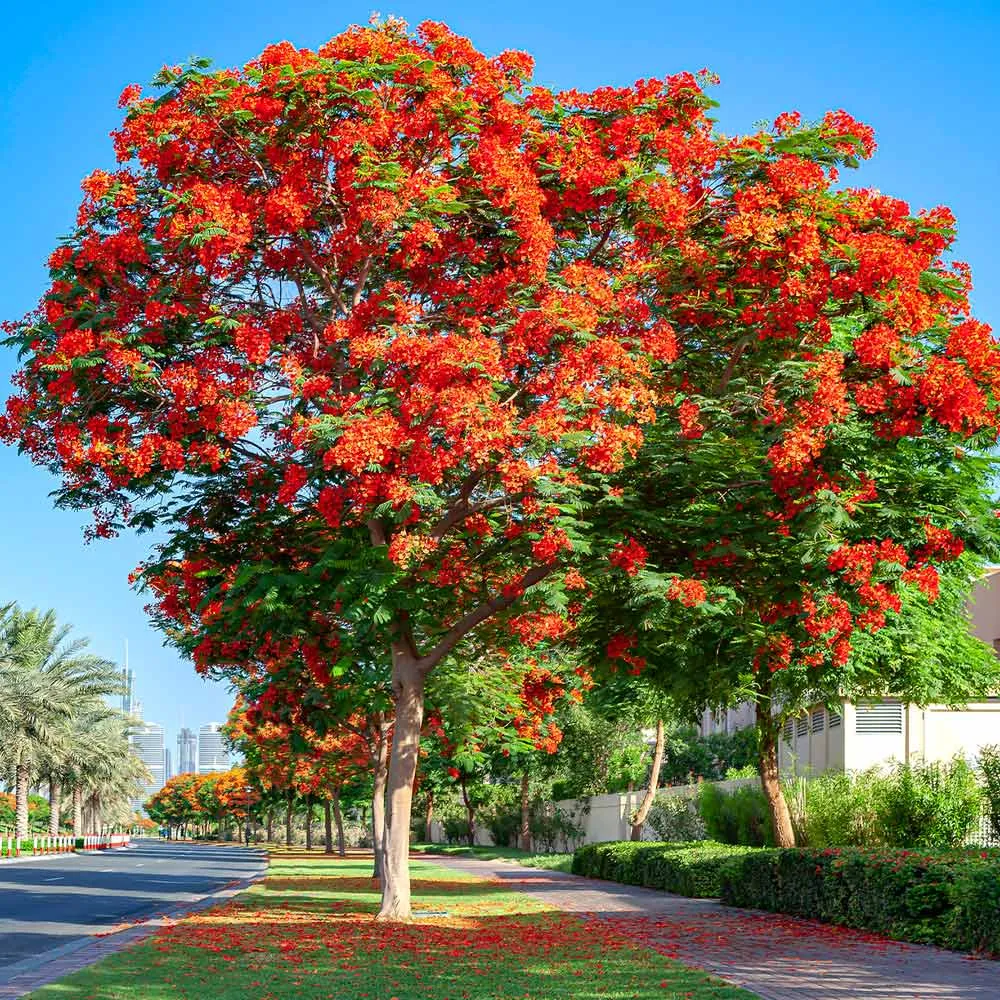
To those who plan to plant royal poinciana trees, I would suggest considering all the pros and cons and then going for it. The Royal Poinciana is a fast-growing evergreen tree that offers stunning crimson blossoms. Though the tree can turn a whole street red-orange in early summer, it's crucial to gather facts about the plant. A mature Royal Poinciana tree can spread 40 to 60 feet, drops seed pods about 18 inches long, and often takes five years or more to bloom. If your yard is frost-free and you have real room, it is one of the most rewarding shade trees you can grow. If space is limited or winters dip below freezing, skip it.
I compared University of Florida extension guidance with the most-read care articles, and they don't always agree. This guide sticks to what holds up, flags where sources differ, and tells you what tends to go wrong. If you are still choosing a tree, our list of trees with orange flowers shows how this one compares with the alternatives.
Where a Royal Poinciana Will Actually Survive?
Hardiness advice is where sources differ. The UF/IFAS Gardening Solutions guide says USDA zones 9b to 11. The Missouri Botanical Garden says zones 10 to 12 and warns that the tree dislikes temperatures below 50°F. Several care sites put the hard floor at 45°F. When sources disagree, I go with the stricter number because a young tree burned by one cold night can set you back years.
In practice, that means South Florida, the far southern tip of Texas, warm pockets of coastal southern California and Arizona, and Hawaii. One care site reports that mature trees can ride out brief dips near 25°F, but they can lose leaves and sustain damage, so that I wouldn't plan around it.
Heat can be a problem too. Arizona State University's plant library notes that extreme desert sun in Phoenix can damage royal poinciana and recommends a spot shielded from reflected western light. So warm is not the same as suitable.
If you live in a colder state, this is a greenhouse or conservatory tree. Growing it outdoors year-round is a gamble I wouldn't take.
Planting: Space Comes First, Everything Else Second
Most planting mistakes I see come down to one thing: people plant the tree based on its size at the nursery, not what it will grow into after 20 years. UF/IFAS suggests keeping it at least 10 feet from pavement, sidewalks, and buildings, because the surface roots are large and spread extensively. I would treat 10 feet as the bare minimum, not the target distance, and give it more space if the space allows. That is my opinion, but a 40- to 60-foot canopy has to go somewhere.
The rest is forgiving:
- Sun: It needs at least 6 hours of direct light. Less than that and you get a leafy tree with few flowers.
- Soil: Clay, loam, sand, or gravel all work as long as water drains. Our orange-flowers roundup says "any soil," and I would tighten that to "any soil that drains." Standing water is what kills young trees.
- Salt and Drought: Once established, it tolerates both, per UF/IFAS, which makes it workable near the coast.
- Mulch: A 2- to 3-inch mulch layer, kept a few inches back from the trunk.
- Staking: Only if the tree is wobbly, and remove the stakes within the first year so the trunk builds its own strength.
Do not count on a lawn underneath. Grass grows poorly under the canopy, and the roots outcompete most underplanting. If you are weighing this against another giant, our guide to growing Bombax ceiba covers a similar-sized tree that needs the same warm zones but blooms in late winter instead of summer.
Watering, Feeding and Pruning
Water
Keep a young tree's soil evenly moist but never soggy until the roots establish. After that, it lives mostly on rainfall. Cut back in late fall and winter, when the tree goes dormant. Overwatering a dormant tree is the mistake I would worry about most.
Feeding
Extension-style guides repeat a pattern: a balanced liquid fertilizer 4 to 6 weeks after planting, then 2 to 3 times a year for the first three years, in early spring and fall. Once the tree matures, one horticulture site suggests shifting to a phosphorus-rich feed to support flowers. A gardening Q&A source adds that too much nitrogen gives you a healthy green tree with hardly any blooms. Keep that in mind if your lawn fertilizer runs off toward the roots.
Pruning
This is where the tree gets expensive if you get it wrong. UF/IFAS advises pruning early so branches attach well to the trunk, removing major limbs that reach half the trunk's diameter, and doing the work in late March to April, just before spring regrowth. Train the main limbs to sit 8 to 12 feet off the ground.
Then there is the caution from a UF/IFAS Broward County arborist. Royal Poinciana is a poor compartmentalizer, meaning it seals off cut wounds badly, so large cuts on a mature tree invite fungal decay. Her example was a big tree that collapsed on a calm day because of hidden rot at a branch union, where a staghorn fern had held moisture for years. My takeaway: keep it small, and don't attach ferns or orchids in the crotches.
Bloom Timing
UF/IFAS says flowers appear from May to July and can last a month or more. A new tree typically takes five years to bloom, with some taking twelve or longer. The Missouri Botanical Garden says seed-grown trees often wait 7 to 10 years. If you want flowers sooner, buy one that is already blooming.
What Goes Wrong (and Why I Still Think It's Worth It for Some Yards)?
Pests are rarely the issue. UF/IFAS lists no major pest or disease problems, and the sources that mention caterpillars, aphids, or scale describe them as minor. The real friction is mechanical:
- Pods: The fruits are about 2 inches by 18 inches, hang on through winter, and drop in spring. Plan on raking.
- Weak Wood: Branches snap in high winds. The tree usually recovers, but it is not a good pick for a spot over a driveway, a parked car, or a play area.
- Roots: Surface roots lift pavement and can choke out nearby plantings.
- Spread: UF/IFAS says to use it with caution in South Florida and manage it so it does not escape into natural areas. Clearing pods helps.
Suppose your problem is that a tree only gives leaves but not the flowers; identify the reason for that. Possible causes include insufficient sun, a cold spell that damages buds, a dry stretch while buds were forming, too much nitrogen, or simply immaturity. Check the last one first. Look around the neighborhood. If nearby poincianas are blooming, weather is not the cause.